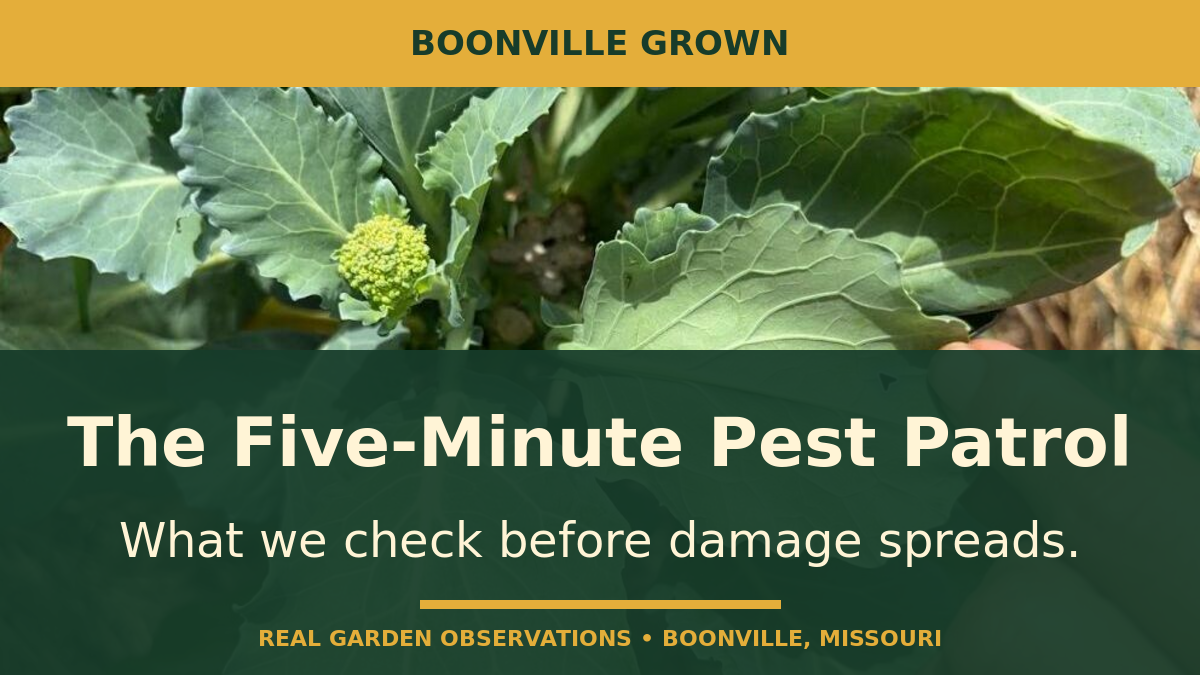
A garden does not need to look overwhelmed before it deserves a closer look. Some of the most useful checks happen when the plants still appear healthy—before a few eggs, a feeding caterpillar or a group of beetles becomes a larger problem.
At Boonville Grown, the goal is not to treat every imperfect leaf. It is to notice clues, confirm what is present and choose the next step from evidence instead of assumption.
Our daily route
Each plant receives an individual check every day. I usually inspect about 20–30% of the plant: a few leaves from different levels, tender new growth, stems, blossoms and any area that already looks different. If I find a clue, I slow down and investigate that plant more thoroughly.
That makes the route repeatable without pretending that every leaf can be examined during every walk.
What makes us look closer
Chewing holes are one clue. Stem stripping, unusual leaf streaking, wilt, frass, a live insect or an egg cluster can also signal that a plant needs a closer inspection.
The top of a leaf rarely tells the whole story. Eggs and young larvae may be easier to see underneath, while frass or fresh feeding can help show that damage is active rather than old.
A hole proves that tissue is missing. It does not, by itself, prove what caused the damage or whether the culprit is still present.
What this patrol found
This morning’s check moved quickly until the clues became specific.
Blister beetles were actively chewing older green-bean leaves. Caterpillar larvae were making new holes in mature broccoli leaves. Egg clusters appeared on the undersides of leaves on multiple plants, and frass provided another sign of active feeding.
That combination—visible damage plus the insect, eggs or frass—gave us enough information to respond instead of guessing.
The response matched the finding
The blister beetles and caterpillars were hand picked and disposed of. Gloves are a sensible precaution around blister beetles because they contain cantharidin, which can irritate or blister skin if the beetles are crushed.
The egg clusters were removed with clear tape. A small piece of tape was pressed gently over the eggs and lifted slowly. The tape was then folded sticky-side in, pressed closed and discarded so the eggs could not hatch.
Mature broccoli, fall broccoli and cauliflower were sprayed with a BT product for the feeding caterpillars. BT products work only when the correct target larva eats treated plant material, so product selection, timing, coverage and label directions matter.
Why the recheck matters
Removal is not the end of the patrol. The affected plants will be checked again this evening after the morning removal work. The entire garden will receive another check tomorrow morning.
That follow-up helps answer questions a single walk cannot: Did fresh feeding stop? Are more eggs present? Did another caterpillar remain hidden? Is the newest growth still healthy?
Sources and further reading
University of Minnesota Extension: Squash bugs
University of Missouri Extension: Bt biological insecticide: Timing and target matter
Five minutes will not answer every garden question. It can reveal where attention is needed—and where patience is the better response.
Reader field notes
Checking the garden gate…